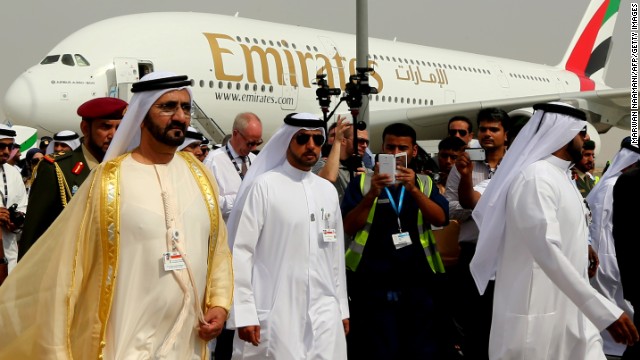
The headline deal is
Emirate's eye-popping, jaw-dropping deals for 150 Boeing 777X airliners
and 50 Airbus A380s, which comes at a time when other airlines are
shunning the superjumbo.
Airbus risked ending the
year without any A380 sales until the Emirates' order arrived. The
industry wondered whether Airbus was going to slow down the A380
production line because of a lack of orders, as Boeing has done with its
747-800 assembly line. Emirates saved the day -- which, I confidently
predict, means Emirates boss Tim Clark got a very good price for his new
planes, way below the $403.9 million list price. With this order
Emirates is the A380 fleet, owning more than 50% of all orders of the
airliner.

CNN's Richard Quest
Then there's the sheer
number of Boeing 777X planes being ordered. Of the 259 planes announced
at the Dubai launch of Boeing's revamped long haul aircraft, Emirates,
Etihad & Qatar bought 225 of them! Poor Germany's Lufthansa snapped
up 34 to be a launch customer, but no one is in any doubt: it will be
the "Gulf Three" who will be back in the years ahead to take more by the
dozen.
It sends a very strong
message. The Gulf Three's position as global carriers is established and
will only grow stronger. Emirates are already the largest airline in
the world, after the U.S. carriers, as defined by Revenue Passenger
Kilometers (the number of paying passengers multiplied by the number of
kilometers flown.) All those wide-bodied planes with lots of seats mean
they have the capacity to shift large numbers of people.
The U.S. carriers only
maintain the top spots in the rankings because of their big domestic
route network -- but internationally Emirates are number one and
widening the gap over the competition. Take New York, where Emirates
sends 2 A380s and a 777 every day to connect to their Dubai headquarters
-- and there are plans to upgrade to 3 A380s as soon as possible.So why is this worrying? Capacity! All these big planes have to be
filled and there is a saying in the industry -- old planes never die,
they just go into someone else's fleet. Many of the planes being ordered
today in Dubai will replace aging planes in existing fleets. Those
older aircraft won't be scrapped; they will be sold to secondary
airlines at a cheaper price, and those airlines will often slash fares
to fill the seats.
Capacity is the biggest
killer of the industry in a downturn. It happened in 2001 where slowing
demand turned the overcapacity into a crisis after the 9/11 terror
attacks in New York. It happened again during the financial crises of
2008. Airlines found themselves with too many seats and too few
passengers and had to mothball planes and slim down.
For the moment, the
industry is enjoying growth of around 5% a year -- and with new markets
emerging, the strong growth in aviation is continuing in front of our
eyes. The worry is what happens when that slows and who gets hurt. I
guarantee you it won't be the Gulf Three.
Forget arguments about
subsidies, unfair competition, state-controlled airlines: Today's orders
in Dubai are further evidence that the shift in aviation is happening
even faster than most had believed likely. There may be much fuss made
over the soon to-be-merged American Airlines & US Airways and the
fight in the brutal skies of the U.S. domestic market, but globally, the
Gulf Three are hoovering up the passengers.
None of these points
will worry the Gulf Three. Capacity issues are someone else's problem
for the time being. They are sitting pretty in the sweet spot of the
new-world order in aviation. They have billion dollar brand-new airport
hubs, sit at the crossroads of the world's growing markets and are able
to connect any two points on the globe using the dozens of wide-bodied
long-haul jets they have just bought.
Most important of all,
the Gulf Three have their own individual strategies for growth. It's
everyone else that's worried, and they should be.

No comments:
Post a Comment